v0.2.4 · open source core

Hardware linting
before you fabricate

Architon catches voltage mismatches, power budget failures, and integration errors in your embedded designs - before you spin a board. Architecture checks for hardware.

Open source core Runs locally No design data leaves your machine
-zsh Architon CLI
$ rv scan .
→ scanning project.net
→ discovered .architon/meta.yaml
→ propagating voltages from sources...

info VBAT = 24.0V (source)
info +5V = 5.0V (U3 regulator out)

RULE_OVERVOLTAGE
component: U1 (TI TMS320F2837xD)
net: VBAT → 24.0V
max: 5.5V
margin: −18.5V

1 violation found · exit code 2

# CI pipeline stops. Board spin avoided.

Fails CI before fabrication when electrical limits are violated

CI: FAIL · 1 violation
DRC: PASS
build blocked before fab
Apache 2.0 · open source core
CI-native · exit codes 0–3
Deterministic · no AI guessing
KiCad · BOM · netlist import

The problem

EDA tools check your layout.
Nobody checks your architecture.

KiCad and Altium verify that your copper is routed correctly. They don't know if your motor driver can handle the battery voltage you've chosen. That failure shows up at bring-up - after you've paid for boards.

existing tools
KiCad ERC / Altium DRC
Checks connectivity, pin types, copper clearances, unconnected nets. Runs inside the EDA tool on your schematic and PCB.
✓ Unconnected pins

✓ Short circuits

✗ Cross-component voltage compatibility

✗ Power budget failures

✗ Driver-motor current headroom
architon
rv scan · system-level verification
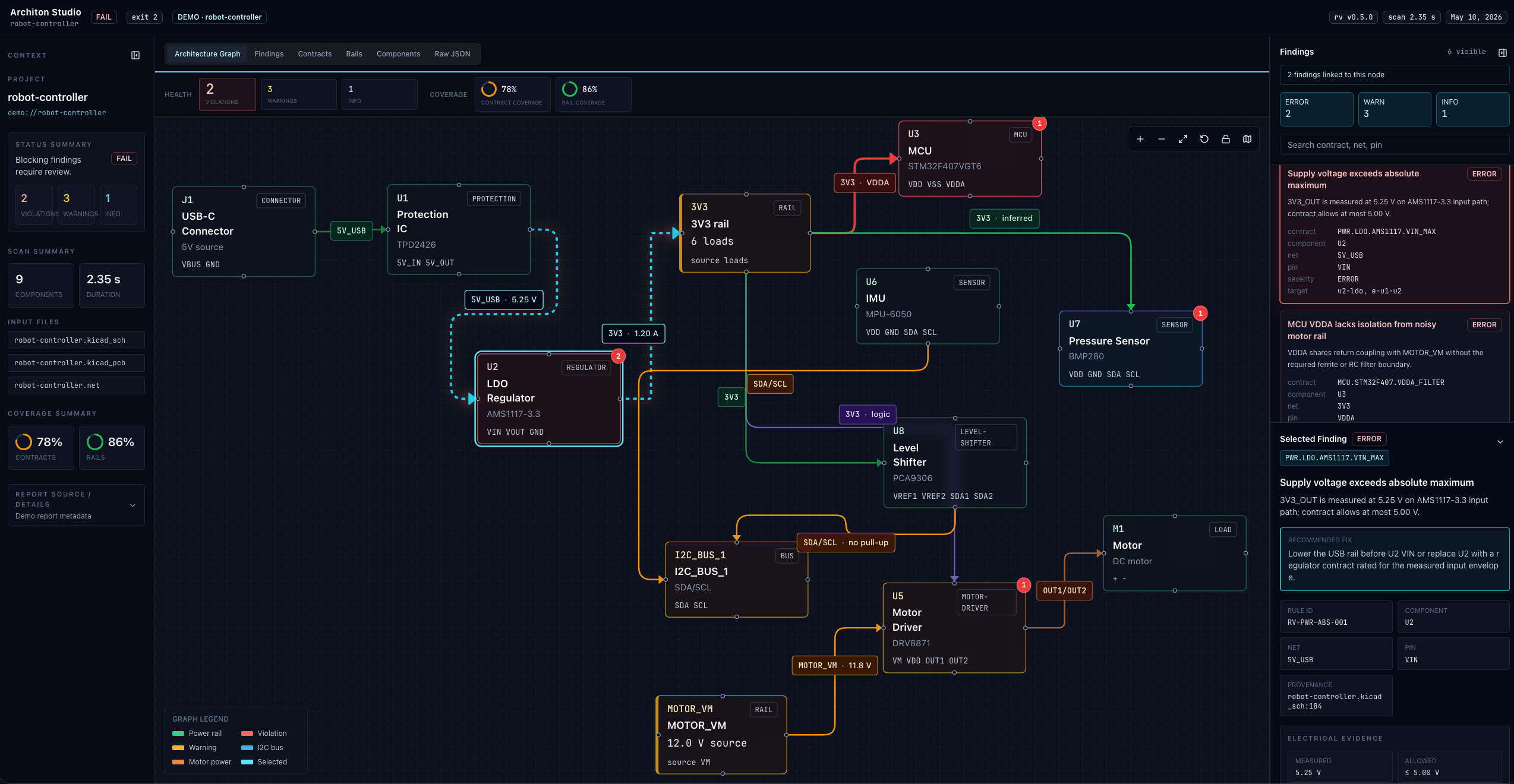
Reads your KiCad netlist + BOM, propagates voltages through the design, and applies electrical compatibility rules against component datasheets.
✓ Overvoltage rules

✓ Power budget violations

✓ CI exit code on violation

✓ Deterministic · reproducible

✓ Runs before fabrication

Verification coverage

ERC and DRC catch schematic and layout issues. Architon checks cross-component electrical assumptions before fabrication.

Check EDA ERC / DRC Architon
Unconnected pins
Copper clearance / layout rules
Cross-component voltage compatibility
Power budget limits
Driver / load current headroom
CI failure before fabrication Not native

Example: a 24V rail connected to a 5.5V-rated component may pass ERC/DRC, but Architon fails the scan before fabrication.


Capabilities

What Architon catches

Rule coverage for the failure modes that destroy board spins and delay shipping.

Voltage propagation

Traces voltages from battery sources through regulators across your full netlist. Flags any net where a component's rated maximum is exceeded.

Motor driver rules

Validates H-bridge and DC motor driver configurations. Checks supply ranges, continuous and peak current, and logic voltage compatibility.

Power budget analysis

Aggregates current draw estimates per rail. Catches designs where total load exceeds regulator or source current limits before the hardware arrives.

CI integration

Exit codes 0–3. Drop rv scan . into GitHub Actions and block merges on architecture violations, not just linting.

KiCad native

Reads .net and BOM exports directly. Auto-discovers project structure. Designed to run on real KiCad projects, not toy demos.

Structured reports

JSON violation output with net names, component refs, voltages, and margins. Parse in scripts, attach to design reviews, or feed into your own tooling.


How it works

From netlist to violation in seconds

No cloud. No account. Runs locally on your hardware project directory. No design data leaves your machine.

01

Install and point at your project

Install the rv binary via Go or download a pre-built release. Run rv scan . in any directory containing a KiCad .net file.

go install github.com/badimirzai/architon-cli/cmd/rv@latest
02

Architon generates a meta skeleton

On first run, Architon auto-discovers your netlist and creates a .architon/meta.yaml pre-filled with your nets and component refs. You add voltage sources and component ratings - nothing Architon can't infer from your BOM.

Created .architon/meta.yaml
03

Scan runs deterministic rules

Architon propagates voltages through regulators, checks each net against component max ratings, and applies rule modules for motors, power, and logic interfaces. No probabilistic inference. Same input → same output, every time.

exit 0 · exit 1 · exit 2
04

Block CI on violations

Exit code 2 stops the build. Violations include net name, component reference, measured voltage, rated maximum, and margin. The team sees the failure before anyone orders boards.

rv scan . ← GitHub Actions
$ go install github.com/badimirzai/architon-cli/cmd/rv@latest

Pricing

Start free. Pay when it saves you a board spin.

The CLI core is open source forever. Paid tiers add AI-assisted explanations, team features, and priority parts coverage. Used on real hardware designs during development

Typical use cases

Open Source
€0 / forever
For individual engineers evaluating Architon
  • rv scan · rv check locally
  • Voltage propagation rules
  • Motor driver rule set
  • CI exit codes 0–3
  • JSON report output
  • AI violation explanations
  • PDF design review reports
  • Team shared rule sets
View on GitHub
50% cheaper
Team
€49.90 / seat / month
For hardware teams running Architon in shared CI pipelines
  • Everything in Pro
  • Minimum 10 seats
  • Team shared rule sets
  • Custom component database
  • Slack / webhook violation alerts
  • Dedicated onboarding call
  • Priority support SLA
Talk to us →
Enterprise
Custom
For organizations deploying Architon across teams and projects
  • Design data never leaves your infrastructure
  • Security and IP protection support
  • Unlimited users
  • Priority support
  • Private rules
  • On-prem / air-gapped deployment
  • SLA
Contact sales →

Enterprise & OEM contracts

Custom rule libraries for your component ecosystem, on-premise deployment, SSO, audit logs, and SLA-backed support. Pricing by seat volume or design-file throughput.

Contact sales →

Get early access to Architon

If your team is building robotics, EV, or industrial equipment - we want to work with you directly. 30-day evaluation for hardware teams building real systems.

No sales calls. No commitment. We'll reply within 48 hours.